The Super Robot Wars series is a long running franchise with a dedicated fanbase, both in and outside Japan. Despite the fact that the series is only released in its native Japanese language and never been localized in English, it never stop international fans from playing the games and enjoying it. In fact, fans never have any expectations of seeing a mainline SRW being released in English. This is understandable as there are a lot of licensing issues that needs to be sorted out due to the huge list of mecha series involved in each games. Their spin-off series Original Generations has had a few English releases (two on the Game Boy Advance platform and one on the Playstation 3/4 platform), but those are understandable due to the mechas and characters involved belonging mostly to Banpresto (the studio involved in making the SRW series).
Therefore, it comes as a huge surprise when the announcement of Super Robot Wars in V back in 2016 is followed up by the announcement of the game being released in Asia region with English text! The announcement is made to celebrate the series 25th anniversary, and with the spin-off Original Generations (OG) game Moon Dwellers also coming out in Asia with English text, it is truly a year of celebration for the SRW franchise.
Unfortunately for those who have played SRW Z3 Tengoku on the PS3, SRW V features a cast list where 2/3 of its cast are recycled straight from Z3 Tengoku. Z3 Tengoku was released in 2015 and the game itself is quite long and feels sluggish at times, so having a new game where more than half of its cast being recycled from Z3 within two years can burn some people out.
Fortunately, the remaining series more than made up for it and the buzz certainly manages to overcome the negativity from the recycled aspects. Featuring the debut of the following series:
- Mobile Suit Gundam: Hathaway’s Flash
- Mobile Suit Crossbone Gundam: Skull Heart
- Mobile Suit Crossbone Gundam: Steel Seven
- Brave Express Might Gaine
- Shin Mazinger ZERO vs Ankoku Daishogun
- Space Battleship Yamato 2199
- Cross Ange: Rondo of Angel and Dragon
this marks the first time that a battleship-only series makes its debut in an SRW game. This is also the first time that we’re getting another show from the Brave series, with the only other representative so far being Gaogaigar in past games. This game also marks the return of ZZ Gundam which were last seen in SRW Alpha 3 in 2005 (or Advance Portable in 2008 if we’re counting ports and remakes) and Nadesico: Prince of Darkness which were last seen in SRW W in 2007. No, we don’t talk about SRW OE here.
Mechanics-wise, the game introduced the TacP (Tactical Point) system that allows you to purchase a lot of things using TacP. Examples of things you can purchase with TacP includes unique Power Parts from the Factory, upgrading Grades that gives you a choice of benefits in battles, or buying skill parts for your pilots. These options are available in some games in the past, but they are mostly separated by different currencies. The introduction of TacP in V is made so that they all share the same currency for convenience’s sake.
The biggest improvement coming from the TacP introduction is the ease of customizing your pilots. In the past, purchasing skills and extra stats for your pilots require the currency called PP (Pilot Point). PP is tied to each pilot and are rewarded every time they shot down an enemy. The PP system can be troublesome for Support-type pilots or healers since they mostly spend their time healing instead of destroying enemies. Also, pilots who joined early have the advantage of raking up the kills (thus getting more PP) which means they can be really strong by endgame with enough PP collected. Meanwhile, pilots who joined late have the disadvantage of having low PP to customize and cover up any immediate weak spots. The TacP system removes the limitation of having points tied to individual pilots, which means any pilots can buy skills and increase their stats anytime they want during intermission provided you have the TacP to purchase said skills. This means that any snipers or battleship pilots can straight away purchase useful skills like Hit&Away without having to grind for kills first.
Another improvement that the game made is the ability to cast Spirits anytime you want, which includes during enemy turns. In past games, Spirits can only be used before the player units use specific actions during the player phase. The improvement means that you no longer need to gamble on whether to put up your defensive Spirits or not before your turn ends, which may or may not be a waste if the enemies decide to target a different unit instead. This improvement has significantly reduce the difficulty of the game, with V often being regarded as one of the easiest game in the franchise.
The main characters (MC) of this game are Soji Murakumo and Chitose Kisaragi. Whoever you pick will pilot the VangRay, a prototype mobile weapon with anti-alien warfare weaponry. The Vangray is a good main unit, with the mech itself having high armor while also having a decent mobility stat. The main appeal of VangRay is that it comes with the Repair command, allowing it to heal a nearby ally while also giving itself self HP Regen every turn. It also comes with a Shield, which further helps with its tankiness. Combined with the attacks having a decent range, the VangRay truly feels like a “multipurpose jack-of-all-trades” kind of mech.

Soji is an interesting character with a lot of potential to be a really great and memorable hero. Right from the start, he is already being established as an ace pilot and a war veteran. He participate in a mission against the Gamilas Army, became the sole survivor of his squadron and was left traumatized by the incident. However, it also made him appreciate his life and makes him want to fully enjoy it as long as he could. Unfortunately, the story seems to put a heavy focus on the Yamato crew to the point where it feels like the developers forgot about our main characters halfway through the game. In fact, it feels like the hero of this game is actually the Yamato crew while the story is told from Soji or Chitose’s point of view. I can’t comment on Chitose since I haven’t played her route yet, but Soji has such a great design, cool theme song and an interesting backstory that he could have been a really great MC that can stand on par with the likes of the Z-series MCs, Arnie from UX or Axel and Lamia from Advance.
The battleship Yamato is a really strong unit. In fact, it’s so overpowered that soloing a stage with the Yamato is easily achievable. The unit comes with a barrier that negates any damage below 2500 damage threshold, which means most enemy mobs can’t even scratch the Yamato. The barrier cost 10 EN per attack, but that will never be an issue for the Yamato as the unit comes with EN Regen (M). With the Yamato’s high EN even at an unupgraded phase, it can easily recover 70+ EN every turn. On top of that, the unit has attacks that covers a lot of range with a balanced split between ammo and EN usage. It also comes with three sub-pilots to support the main pilot Okita. Throw the Yamato in the middle of the enemy fleet and watch them die one by one while the Yamato comes out mostly unharmed.

The second Brave series to join the world of SRW is Brave Express Might Gaine. The Might Gaine as a unit is your standard fare Super Robot with high armor, good self-sustenance Spirits and a strong finisher. However, the unit itself is pretty bad at handling multiple units at once. Its low movement, coupled with its low range Post-movement Dorinken attack and its inability to fly often means that the Might Gaine will have a hard time reaching the enemy mobs. It’s a good unit early-game, but it falls off in mid-game onwards.

The upgraded form of Might Gaine though is a completely different beast. Packing a lot of attacks that have good range and firepower plus having the ability to fly, the Great Might Gaine is a really powerful unit that really fit its ‘Brave’ motive. While the unit suffers from its attacks consuming a large amount of energy, its main flaw can easily be fixed by giving energy-related power parts to the unit. In fact, purchasing the Hyper Generator (restore EN to full every turn) and giving it to Great Might Gaine will pretty much turn it into a one-man army. Give it the Barrier Field power parts and it will turn into an unkillable Ultimate Super Robot!
The next series that I’ll be covering is Cross Ange. All the main girls in the anime are playable in the game, though their units mostly function the same gameplay-wise. Being the main character of her show, Ange is the stand-out pilot from the series and consistently stays strong throughout the game. Her unit, the Vilkiss has high movement, high mobility and good range of attacks. A powered-up Vilkiss comes with HP Regen, EN Regen and a special evasive ability called Ariel Mode. To further emphasize on the unit’s evasiveness, Ange comes with an innate Potential level 8 (increase the pilot’s stats the lower their unit’s HP is) and an Ace Bonus that further increase the unit’s final evasion rate.
The rest of the Para-Mail units from Cross Ange are pretty unremarkable. Ersha has a cheap Trust spirit, but Tusk will outperform her in the support role as soon as he’s available. Hilda is a good offensive pilot, though her initial mech is pretty underwhelming which means she will have to wait for her upgraded mech before she can really shine. Salad Salako is a great long-range attacker and a good Support Attack candidate. Her mecha’s Custom Bonus reduce the energy cost of her Convergence Space-Time Cannon to only 10 EN, effectively making her a really good unit to deal with enemy mobs.
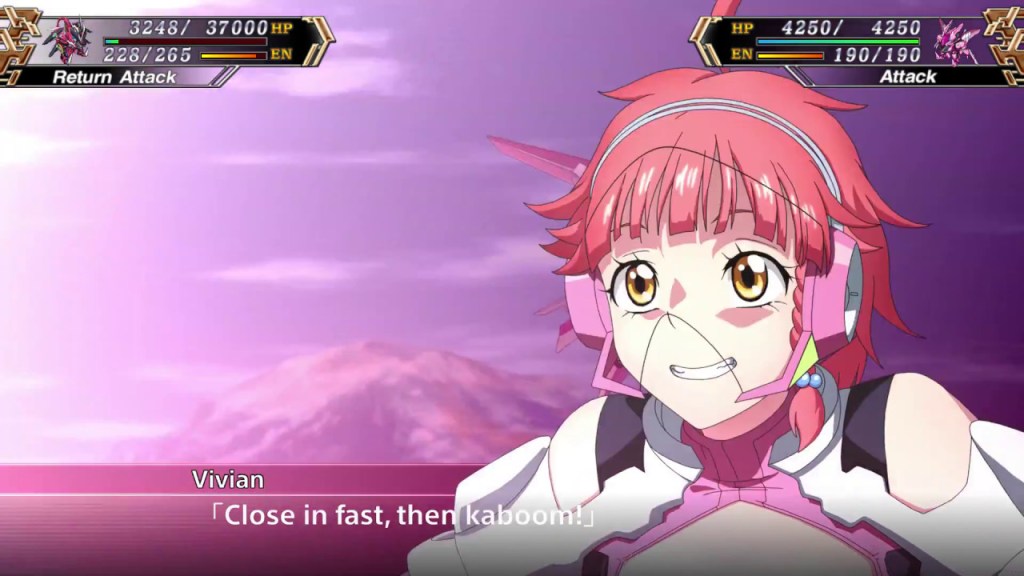
Vivian deserves a special mention due to how useful she is as a support. The Daunt spirit command can reduce an enemy’s Morale by 10. This spirit command is useful if you want to disable an enemy’s defensive abilities or prevent them from using their strong attack, or worse, their MAP attack. Normally Daunt can be expensive to cast on top of only a select few pilots having access to it. Vivian’s Daunt is cheap, and with some investment and power parts that boost or recover her SP she can spam the Daunt command over and over. She can effectively turn any bosses into a joke due to her Daunt spam, preventing them from doing anything remotely dangerous. On top of that her Ace Bonus gives us a fixed power part after every stage completion, allowing us to sell said power part for TacP. Her mech, the Razor also comes with three power part slots (four from the full upgrade bonus) giving us a lot of freedom in further specializing her role. Want to use her offensively? Give her a Cartridge and some damage-boosting power parts. Want her to stay in backline? Give her Rescue Unit so she can heal others and a Barrier Field for self-defense. Want to be a sadist? Give her all the SP recovery parts and let her spam Daunt for days.
The Xi Gundam from Hathaway’s Flash is a good long-range unit. However, the mech is wasted on its average main pilot Hathaway. This is understandable because it’s Hathaway we’re talking about. Funnily enough, the Xi Gundam have more synergy with Kincaid from the Crossbone Gundam series. Kincaid’s innate Hit&Away, high Newtype and Potential level plus access to Snipe spirit command makes him a really good pilot for the Xi Gundam. Later on with the acquisition of Crossbone Gundam X-1 Full Cloth, Kincaid will have the choice of using the Xi for long-range or X-1 Full Cloth for melee combat. Alternatively Tobia can pilot the X-1 while Kincaid remains in the Xi. Who uses Hathaway, anyway?
Mazinger Zero is a monster. That is all you need to know.
Despite the easy difficulty, the game is still fun as it focus on the crossover aspect of the various series involved. For example we get to see the Seed Destiny cast be a mentor figure to the Cross Ange cast, seeing Banagher interact with the likes of Amuro and Camille, the Federation bad guys forming the elite G-Hound force, and seeing our female pilots roasting on Embryo.

One issue that I have with this game is the lack of potential combination attacks here. The Para-Mail squadron are lacking any sort of combo attacks despite all members being playable in the game. Salia and Hilda should have had access to their formation attack with their respective squads, while Ange and Salamence Salako should have had access to their Double Convergence Space-Time Cannon combo attack. We have the Ple twins from ZZ Gundam and Marida from Unicorn Gundam in the same game, and it would have been fun if we can get a Triple Funnel combo attack from these girls. We have Shin-Getter 1, Mazinger ZERO and the debut of Mazin Emperor G, and yet we are denied from a potential Final Dynamic Special.
For a game that celebrates the franchise’s 25th anniversary, SRW V is a decently fun game if you can look past its easy difficulty. It’s nowhere near as great as some past games, but the introduction of the TacP system makes it really convenient for you to just play around with your favorite pilots/units right off the bat. For English speakers, SRW V marks the moment where a mainline SRW is finally localized in English. For those interested in the franchise but never had the chance to try it out, SRW V is a good entry for you to start with.
 HentaRobot's Game Reviews